Precision springs
Custom Torsion Springs
Precise Torque Control | Fatigue-Resistant Leg Design | Multi-Material Customization | Rotation Reset Experts
Request a QuoteSend your drawing, required quantity and application details. Our Dongguan team will review the part directly.
Product Description
I. Overview
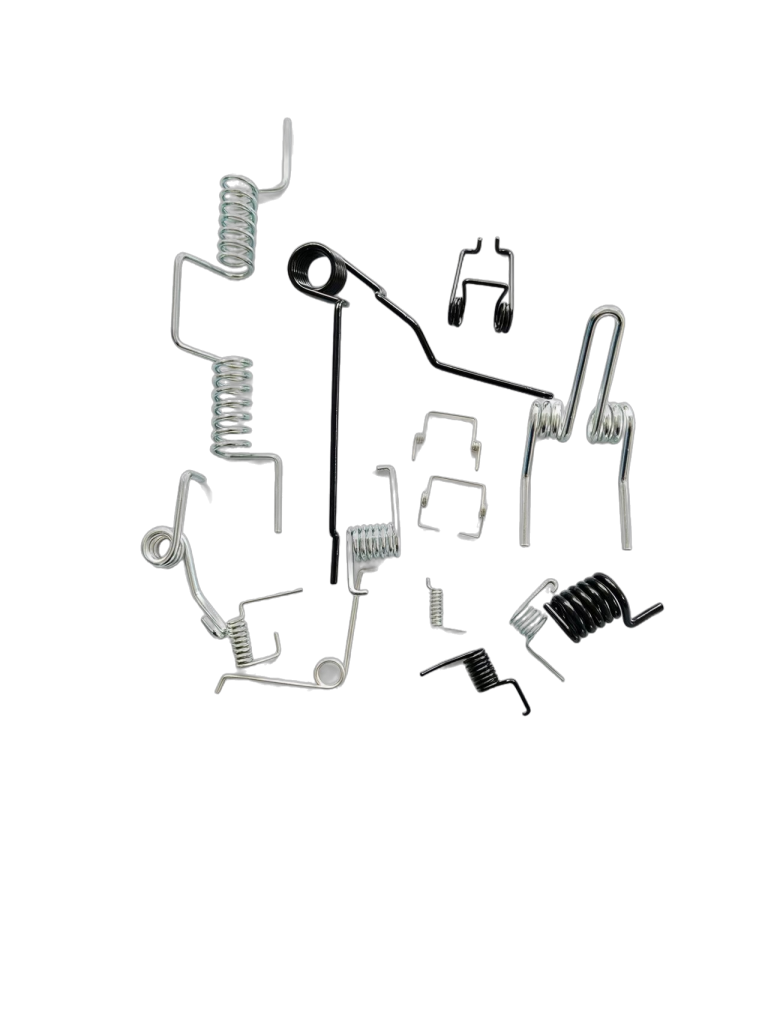
A torsion spring (abbreviated as "torsion spring") is a helical spring that uses the lever principle to generate torque by applying a rotational force to its end legs. It is mainly used for rotational resetting, snap-fit clamping, and hinge support in mechanical mechanisms. "The core of a torsion spring lies in precise torque and robust legs. We don't just manufacture to drawings—we also conduct professional leg stress analysis to ensure that every torsion spring will not break or lose force in your rotational mechanism, perfectly achieving thousands to millions of reciprocating torsion cycles."
II. Core Technologies
Precise Torque Control: The force value of a torsion spring is expressed as "torque" (N·mm or kgf·cm). Using precision CNC spring coiling machines, we strictly control the number of coils, inner diameter, and leg angle to ensure precise torque at a specific rotation angle.
Fatigue-Resistant Leg Design: The junction between the leg and the spring body (R-angle) is the "Achilles' heel" where torsion springs most easily fracture. We have extensive end-forming experience and can process straight legs, outward-bent legs, inward-bent legs, center bends, and other shapes. By optimizing the bend radius, we greatly eliminate stress concentration.
Left/Right Hand Winding Customization: Torsion springs are available in left-hand (clockwise wound) and right-hand (counterclockwise wound) directions. We can precisely customize the winding direction based on your force direction to ensure that the inner diameter decreases (gripping the shaft) rather than increases (causing binding) under load.
Inner Diameter Shrinkage Calculation: The inner diameter of a torsion spring decreases during torsion. Our engineers precisely calculate the inner diameter after torsion based on your rod dimensions, preventing the spring from locking up or causing friction noise.
III. Material Capabilities
We support customer-specified materials to meet different corrosion resistance, temperature resistance, and conductivity requirements:
Carbon Steel Wire / 65Mn / Piano Wire (SWP): High elasticity and high fatigue life, suitable for general machinery, automotive, and home appliance internal components.
SUS304 / SUS302 / SUS316: Excellent rust prevention and corrosion resistance, suitable for outdoor, kitchen equipment, medical devices, and humid environments.
SUS631 (17-7PH): Precipitation-hardening stainless steel, high-temperature resistant (300°C+) with extremely strong resistance to relaxation, suitable for aerospace and high-strength industrial valves.
Phosphor Bronze / Beryllium Copper: Good electrical conductivity, magnetic resistance, and wear resistance, commonly used in electronic connectors and precision instruments.
IV. Applications
Torsion springs are the core component for achieving "automatic flipping" and "springback":
Home Appliances: Oven door hinges with slow closing, microwave door latch reset, trash can lid automatic closing, printer compartment door pop-open.
Automotive Industry: Trunk lid hinges, door handle return, sun visor flipping, seatbelt buckle positioning, center console armrest box.
Hardware and Construction: Floor spring door hinges, mousetrap/animal trap reset, clothespins, drying rack folding joints.
Electronics and Precision Instruments: Battery compartment covers, micro switch contact pressure, optical instrument lens rotation positioning.
V. Environmental Resistance
High-Frequency Reciprocation and High-Torque Environments: For heavy-duty hinges, we introduce surface residual compressive stress through shot peening, combined with SUS631 material, greatly improving fatigue fracture resistance.
Humid and Salt-Spray Environments: SUS304 is recommended for indoor use; SUS316 is recommended for outdoor or coastal facilities, or Dacromet, electrophoretic coating, or PTFE coating applied to carbon steel parts to ensure long-term rust prevention.
Extreme Temperatures: Austenitic stainless steel is recommended for extremely cold environments; SUS631 or special heat-resistant alloys are recommended for high-temperature environments.
VI. Specifications
| Customization Parameter | Range / Description |
|---|---|
| Material | Carbon steel, piano wire, 65Mn, SUS304/316/631, copper wire, etc. |
| Wire Diameter (d) | 0.2mm ~ 15.0mm |
| Outer Diameter (D) / Inner Diameter (ID) | Customized per drawings (confirm whether it operates on a shaft) |
| Winding Direction | Left-hand / Right-hand |
| Free Angle | Angle between legs (e.g., 90°, 180°, etc.) |
| Leg Types | Straight leg, inward-bent leg, outward-bent leg, extended leg, hooked leg, etc. |
| Surface Treatment | Black oxide, zinc plating, nickel plating, Dacromet, electrophoretic coating, PTFE, etc. |
VII. Why Choose Us?
Engineer-Based Life Optimization Design for Your Working Conditions: We are not just a contract manufacturer. Our engineers will help you calculate the allowable bending stress based on your actual working conditions (working angle, assembly space, load frequency). If your drawings have hidden risks such as easily broken legs or unreasonable force design, we will proactively suggest adjusting the spring inner diameter or leg bend angle, fundamentally helping you design a torsion spring that meets or even exceeds the expected service life.
Professional Torque Testing: Equipped with high-precision torque testing machines, we can provide detailed "Torque-Angle" test curves to ensure batch-to-batch consistency.
Rapid Prototyping and No MOQ Threshold: From dozens of prototypes in the early R&D stage to mass production, we treat all with the same quality standards.
Free Design for Manufacturability (DFM) Analysis: Provide 2D/3D drawings, and we will help you evaluate processing difficulties and cost control solutions.
Questions about this part
Sizing, material and inspection for this spring. Anything else, open the quote form and a tooling engineer replies.
Ask about this partWhy is it essential to specify the winding direction (left-hand/right-hand) when designing a torsion spring?
This is very important! To ensure the spring "grips" the rod (inner diameter decreases) during torsion, a right-hand wound spring is typically subjected to a clockwise force, while a left-hand wound spring is subjected to a counterclockwise force. If the winding direction is specified incorrectly, the inner diameter will increase under load, causing the outer diameter to expand and bind, and the force value will also be inaccurate.
The legs of our torsion springs tend to break. What solutions do you offer?
Leg fracture is usually caused by excessive stress concentration due to too small a bend radius (R-angle). Our engineers will recommend increasing the R-angle or changing the leg type, and ensure that sufficient stress-relief tempering is performed after forming. If necessary, the material can be switched to piano wire or SUS631 for better toughness.
What rotation angle can a torsion spring withstand?
The recommended working rotation angle is generally no more than 120°–180° (depending on the spring index and material). Forcing the spring to rotate beyond this angle will cause permanent deformation. We can redesign the spring based on your maximum angle requirements.