Precision springs
Custom Extension Springs
Precise Initial Tension Control | Fatigue-Resistant Hook Design | Multi-Material Customization | Built for Harsh Environments
Request a QuoteSend your drawing, required quantity and application details. Our Dongguan team will review the part directly.
Product Description
I. Overview
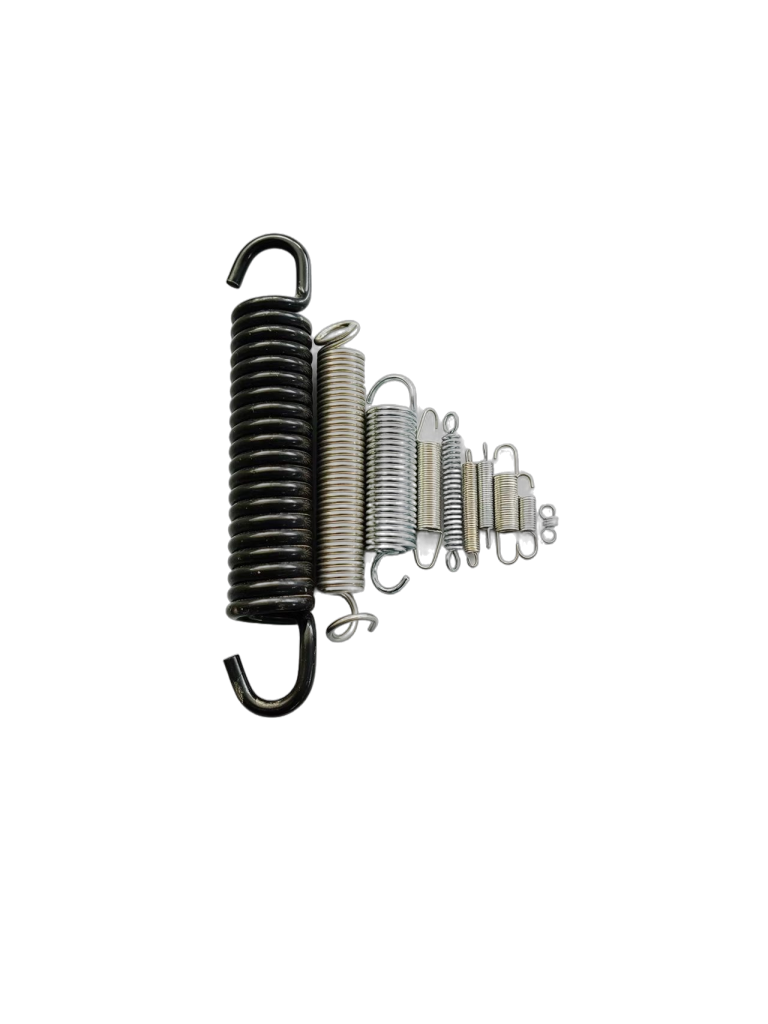
Extension springs (abbreviated as "extension springs") are helical springs that bear axial tensile loads, mainly used to control mechanical motion, absorb vibration, or provide reset functions. "We understand that extension spring failure often occurs at the hooks. From material selection to hook forming and stress-relief tempering, we strictly control every process to provide you with customized solutions featuring precise tensile force, robust hooks, and long service life." Whether your equipment requires a tiny precision tension or a heavy-duty high-strength traction, we can customize to your drawings.
II. Core Technologies & Advantages
Precise Initial Tension Control: The "initial tension" of an extension spring is generated during tight coiling. Through precision CNC machine adjustment, we ensure stable initial tension in every batch, allowing your equipment to obtain accurate reaction force at the initial extension stage.
Fatigue-Resistant Hook Design: Hooks are the most fracture-prone part of extension springs. We offer various end configurations including half-round hooks, full-round hooks, side hooks, English hooks, German hooks, and threaded connection rods, and optimize R-angle transitions based on force direction to effectively eliminate stress concentration.
Rigorous Stress-Relief Tempering: After coiling and forming, dedicated low-temperature tempering is performed to eliminate internal stresses from coiling and bending, preventing permanent deformation (tension decay) under long-term extension.
Avoiding "Coil Interference": Strictly control the clearance between coils at maximum extension to ensure no physical interference between coils.
III. Material Capabilities
You can specify materials based on your working environment. We support processing:
General Applications: Carbon steel wire, 65Mn (cost-effective, suitable for general machinery).
High-Precision/High-Frequency Applications: Piano wire (SWP) (high dimensional precision, excellent elasticity, suitable for precision electronic components).
Corrosion and Rust Prevention Requirements: SUS304 / 316 / 302 (food-grade, medical-grade, outdoor high-salt-spray environments).
High-Temperature/High-Stress Environments: SUS631 (17-7PH) (high-temperature resistant up to 300°C+, extremely high strength after precipitation hardening).
Conductive/Non-Magnetic Requirements: Phosphor bronze, beryllium copper wire (electronic product contact components).
IV. Applications
Extension springs exist in virtually all mechanical structures requiring "automatic reset" and "tension maintenance":
Automotive Industry: Door handle return, trunk hinges, brake shoe return, seatbelt retractor tension control.
Home Appliances: Washing machine door lock extension springs, microwave door hook extension springs, vacuum cleaner cord reel reset.
Medical Devices: Surgical forceps gripping return, rehabilitation equipment resistance extension springs, dental equipment precision traction.
Machinery and Automation: Automated fixture tensioning, hydraulic valve spool reset, conveyor belt tensioning mechanisms, dust collector filter bag cage stretching.
V. Environmental Resistance
Outdoor Humid Environments: Ordinary carbon steel extension springs rust easily. We recommend SUS304 or SUS316 materials, or applying Dacromet, electrophoretic coating, or environmentally friendly zinc plating to carbon steel to prevent salt spray and rain erosion.
High-Temperature Conditions: Near engines or heating furnaces, ordinary extension springs will experience elasticity decay. SUS631 or heat-resistant alloys are recommended to ensure no relaxation at high temperatures.
High-Frequency Reciprocating Extension: For frequent extension scenarios, we calculate and control working stress within the material's fatigue limit, combined with shot peening, to greatly extend service life.
VI. Specifications
| Customization Parameter | Range / Description |
|---|---|
| Material | Carbon steel, piano wire, 65Mn, SUS304/316/631, copper wire, etc. |
| Wire Diameter (d) | 0.2mm ~ 20.0mm |
| Outer Diameter (D) | Customized per customer requirements (from micro to heavy-duty) |
| Free Length (L0) | Total length including hooks (or connection rods) |
| Initial Tension (F0) | Precisely set according to drawing tolerances or customer testing requirements |
| Hook Types | Full-round hook, half-round hook, side hook, English hook, German hook, etc. |
| Surface Treatment | Black oxide, zinc plating, nickel plating, Dacromet, electrophoretic coating, PTFE, etc. |
VII. Why Choose Us?
Engineer-Based Hook Stress Optimization: Many customer drawings have hooks that tend to straighten or break under load. Our engineers will help you optimize the hook shape and bend radius based on your actual tensile direction, fundamentally solving the hidden risk of extension spring fracture.
100% Tensile Testing: We are equipped with professional spring tension/compression testing machines to ensure that every batch of extension springs meets your design requirements for initial tension and force values at specified extension lengths.
Free Design for Manufacturability (DFM) Analysis: Simply provide drawings or physical samples, and we can provide material recommendations, life assessment, and cost control solutions.
No MOQ Threshold: Whether dozens of pieces for R&D prototyping or large-scale mass production, we deliver with the same quality standards.
Questions about this part
Sizing, material and inspection for this spring. Anything else, open the quote form and a tooling engineer replies.
Ask about this partWhat exactly is the "initial tension" of an extension spring? Can it be removed?
Initial tension is the initial force that a tightly coiled extension spring must overcome before the coils separate. Extension springs typically have initial tension, which cannot be completely removed. If you need zero initial tension, the spring must be wound with "gaps between coils.
My old springs always break at the hooks. What solutions do you offer?
This is usually caused by stress concentration at the hooks or incomplete stress-relief tempering. You can send us samples, and we will analyze the stress conditions, redesign the hook R-angle, or switch to a tougher material (such as piano wire or SUS631).
Can the ends be made with threaded rods?
Yes. In addition to conventional hooks, we can process extension springs with threaded connection rods (internal or external threads) at both ends for direct screw-in installation into equipment.